The new SEAI Battery Energy Storage System Grant is now open, providing homeowners with a flat-rate €600 grant towards an eligible home battery storage system of 5kWh or larger.
The new support forms part of the package of enhanced residential energy measures approved by Government and administered by SEAI.
Alongside the new battery grant, Solar PV grant eligibility has also been extended to homes built and occupied before 2025, opening renewable-energy supports to more Irish homes.
The maximum domestic Solar PV grant remains €1,800.
At EnergyServ, however, the important question isn’t simply:
How much is the grant?
It’s:
“What could Solar PV and battery storage do for my home?”
Because every home is different – and the right solution should be designed around the property and the people living in it.
How much is the new home battery grant?
The new SEAI Battery Energy Storage System Grant provides a flat-rate grant of €600.
To qualify, the battery system must have a capacity of 5kWh or larger. Battery systems below 5kWh are not eligible for the grant.
The property must also:
- Have an MPRN.
- Have been built and occupied before 2025.
- Not have previously received grant funding for a battery at that MPRN.
- Meet the technical and other eligibility requirements of the scheme.
Eligible applicant types include homeowners, private landlords, Owner Management Companies and Approved Housing Bodies.
Already have Solar PV?
Yes. This is one of the most important clarifications under the new scheme.
If you already have Solar PV installed, you can apply separately for the new €600 battery grant, provided you meet the applicable eligibility criteria.
SEAI states that if you are installing only one of the measures now, you may apply for the other at a later date, provided you meet the relevant eligibility criteria at the time of application.
That means homeowners with an existing Solar PV system can now explore whether adding eligible battery storage could help them make greater use of the electricity available to their home.
If you already have an existing Solar PV grant application and would now like to apply for the battery grant, SEAI advises that you do not need to amend the existing Solar PV application. Instead, a new battery grant application can be submitted through the SEAI portal.
Importantly, you must apply for the battery grant and receive your SEAI Grant Offer before any installation work begins.
Installing Solar PV and a battery together?
If you’re planning a new installation that includes both Solar PV and battery storage, you can apply for both grants through one SEAI application.
The maximum domestic Solar PV grant remains €1,800, while the new battery grant provides a flat €600, subject in each case to the relevant eligibility and scheme requirements.
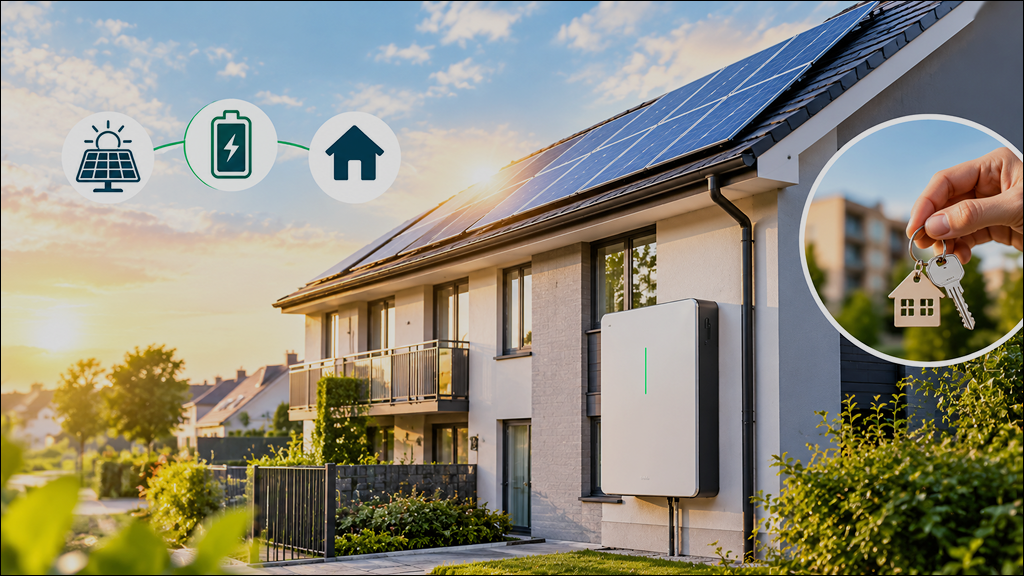
Considering both technologies together also allows the overall system to be designed around how electricity is generated, stored, and used within the home.
What does battery storage do?
Battery storage enables electricity to be stored for later use.
Where a home has Solar PV, electricity generated during daylight hours can be used directly throughout the property.
When the Solar PV system produces more electricity than the home is using at that moment, some of that surplus may be stored in the battery for use later – for example, when the panels are producing less electricity.
This can allow the household to make greater use of the renewable electricity generated at the property.
The benefit of battery storage will depend on factors including:
- Household electricity consumption.
- Solar PV generation.
- Battery capacity.
- Electricity tariffs.
- When electricity is used within the home.
- How the overall system is configured and operated.
That’s why good system design matters.
At EnergyServ, we look at the property, available space, electricity consumption and how energy is being used before recommending a solution.
The aim is to find the right system for the property – not simply add a battery because a grant is available.
What do I need to do before installing a battery?
There are several important steps in the SEAI grant process.
Most importantly:
You must apply for the grant and receive your SEAI Grant Offer before installation work begins.
Applications cannot be made retrospectively for works that have already started.
The battery must also be installed by an SEAI registered Solar PV Contractor and the installation must meet the applicable technical requirements.
Before the battery is installed, the installer must make the required application to ESB Networks to connect the battery system to the electricity network.
SEAI advises that this process usually takes at least four weeks / 20 working days, so this should be factored into the installation timeline.
Once the grant has been approved, the applicant has eight months to complete the works and submit the required documentation. After this period, the Grant Offer expires and the grant will not be paid.
Do I need a BER after installing a battery?
Where Solar PV is present at the property, SEAI requires a post-works Building Energy Rating (BER) assessment before the battery grant can be drawn down.
The assessment must be completed by a registered SEAI BER Assessor.
SEAI recommends arranging the BER once you know your installation date so that it does not delay the grant payment process.
What if my home was built after 2020?
There is good news for owners of newer homes too.
Eligibility for the domestic Solar PV grant has now been extended to homes built and occupied before 2025.
Previously, the published Solar PV eligibility period excluded many newer homes.
The maximum Solar PV grant remains €1,800, subject to the applicable SEAI eligibility criteria.
This means many newer homes that previously fell outside the Solar PV grant eligibility period may now be able to access support.
Budget 2027: What’s changing for income from exported electricity?
Budget 2027 has also announced an increase in the tax-free exemption applying to qualifying profits from domestic microgeneration.
The announced change would increase the exemption from €400 to €600 per qualifying individual.
Under the existing Revenue structure, the exemption applies to each qualifying individual named on the electricity bill.
Subject to the Budget 2027 change being enacted and operating on the same basis, this could mean:
- One qualifying individual named on the electricity bill – potentially up to €600 tax-free.
- Two qualifying individuals named on the electricity bill – potentially up to €1,200 tax-free combined.
This relates to qualifying profits arising from surplus renewable electricity exported to the grid; it is separate from the €600 SEAI battery grant.
Important Budget 2027 note
At the time of writing, Revenue’s detailed published guidance continues to show the existing €400 exemption.
The increase to €600 per qualifying individual has been announced as part of Budget 2027, but updated Revenue guidance and implementation details should be checked before publication.
For that reason, homeowners should not yet assume that the €600 exemption is already reflected in Revenue’s current operational guidance.
Thinking about Solar PV or battery storage?
There are now more options available to Irish homeowners considering how they generate, store, and use electricity.
You may be:
- Considering Solar PV and battery storage together.
- Living in a newer home that may now fall within the extended Solar PV eligibility period.
- Already using Solar PV and considering adding battery storage.
- Looking to understand whether a battery makes sense for the way your household uses electricity.
The right answer will not be the same for every property.
EnergyServ can look at your electricity usage, existing system where applicable and the property itself to help determine an appropriate solution.
And with the new SEAI battery grant now live, it’s important to get the process right from the beginning – including applying for the grant and receiving your SEAI Grant Offer before installation work starts.
Every Property Has Potential.
Register your interest with EnergyServ.
If you’re considering Solar PV, battery storage or both, register your interest with EnergyServ and our team can discuss the options available for your property.
Register your interest with EnergyServ today.